Wednesday, February 26, 2014

The 2014 Church History Symposium

The 2014 Church History Symposium is next week!  Are you going?


I am.  This will be the second year I’ve been able to attend, and I’m looking forward to it.  This year it will be Thursday and Friday, March 6 and 7.  The theme is “The Worldwide Church:  The Global Reach of Mormonism.”   No registration is required, the conference and parking are free, and best of all, Friday’s keynote speaker is President Dieter F. Uchtdorf.  So if you can, come!

The webpage with complete information, including a schedule of speakers and panelists, is here.  The Thursday sessions will be at BYU and the Friday sessions in Salt Lake City.  I will probably attend only the afternoon sessions on Thursday, and all day Friday. 

If any of my friends are going and want to carpool or meet up for lunch, let me know.


Thursday, February 13, 2014

A tale of two Relief Societies: The Female Relief Society of Nauvoo and the Relief Society of the Tithing Hill Ward

As sisters in Zion, we’ll all work together;
The blessings of God on our labors we’ll seek.
How vast is our purpose, how broad is our mission,
If we but fulfill it in spirit and deed.
Oh, naught but the Spirit’s divinest tuition
Can give us the wisdom to truly succeed.
Hymn no. 309.  Lyrics by Emily H. Woodmansee.

I was released from my calling in Relief Society.  I knew it was coming; I’d been teaching for about 2 ½ years, and so I’d been bracing myself.  Still, when the release came I felt really, really sad:  much sadder than I’d expected.    I love the sisters in my ward.  I love teaching them and learning from them.  I also loved learning through the Holy Ghost as I prepared and taught my lessons.  Teaching in Relief Society has been a tremendous blessing to me and I will miss it.

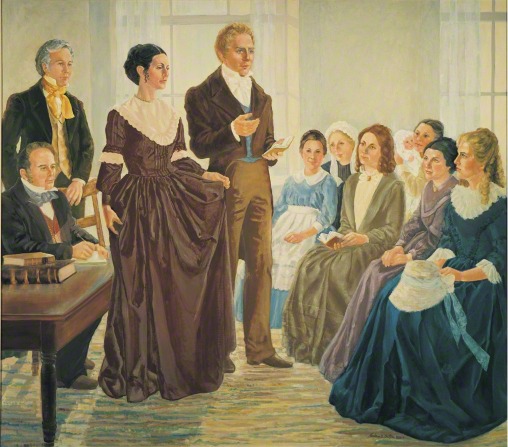
Organization of the Relief Society
Source:  www.lds.org
Blessing women like me was, of course, the purpose of Relief Society from its founding.  Lucy Mack Smith, in 1842, said the following to the Female Relief Society of Nauvoo:  “We must cherish one another, watch over one another, comfort one another and gain instruction, that we may all sit down in heaven together.”1

A bit of an aside before I continue:    In 1835 a Presbyterian minister from New England named Charles Finney published his Lectures on Revivals of Religion.  Finney’s departure from conventional Calvinism helped make his Lectures controversial, but the biggest criticism about his revivals was the role played by women.  Finney not only allowed women to participate behind the scenes, but women in his congregations could speak and pray in public. 2   In 1842, only a few years later, the Church of Jesus Christ of Latter-day Saints organized the Relief Society, granting women members of the Church an official role.  3   Relief Society was revolutionary.

Before I was called to be a teacher in the Relief Society, I had spent several years teaching children in the Primary Organization.  I realized quickly that my lessons to adult sisters would be very different than my lessons to the children.  The sisters in my ward were smart.  They knew a lot about the gospel.  They didn’t need someone to teach, so much as lead a discussion.  We all taught each other, no matter who stood at the podium.
The Female Relief Society of Nauvoo was founded here,
in Nauvoo's "red brick store"
Photo by John Hamer
Source:  wikimedia commons

During the first meeting of the Female Relief Society of Nauvoo, (17 March 1842) Joseph Smith read  D&C section 25.  He clarified verse 7:  “And thou shalt be ordained under his hand to expound scriptures, and to exhort the church, according as it shall be given thee by my Spirit,” explaining,”[Emma] was ordain’d at the time, the Revelation was given, to expound the scriptures to all; and to teach the female part of community; and that not she alone, but others, may attain to the same blessings.”
In a later meeting (28 April 1842), President Joseph Smith discussed chapter 12 of 1 Corinthians.  Each sister in Relief Society has different spiritual gifts, he explained, and God needs all the sisters. 5   I remember learning the same thing as I taught Relief Society in the Tithing Hill ward.  I am a left-brain thinker.  When I teach, my lessons are very organized and logical.  Sometimes I struggle to connect emotionally with the sisters in the room.  The other sister who taught from the Teachings of the Presidents of the Church manual, however, was really good at this.  Sometimes I would watch Sister Musselman teach, look at the emotional responses of the others in the room, and wonder, wow, how does she do this?    After a few months of watching her I realized that God had called both of us to teach for this very reason:  He had given each of us talents in teaching, and He needed both of us, with our different strengths.  I could talk about what I thought, and she could talk about what she felt, and together we could reach everyone in the room.

God depends on all His daughters to use their different abilities to build the kingdom.  In Nauvoo the sisters donated time, money, and work.  The sisters who cooked gave food.  The sisters who spun gave flax and wool.  The sisters who sewed donated clothing or embroidery.  Some sisters gave soap, or collected donations, or tended the sick.  Though they gave differently, they all gave something.  They gave to the poor and needy and, during the spring of 1843, they also donated to the temple.  Despite their differences, they all wanted to serve God, assist the poor, and receive their temple covenants.  In my ward, also, I found that we Relief Society sisters are alike in the most important ways.  As we discussed motherhood, I learned that every mother, married or single, working at home or in a career, worries about her children.  I learned that every woman in Relief Society loves the Lord, wants to serve Him, and feels inadequate.

I’ve learned a lot from Relief Society over the past 2 ½ years.  Much of what I’ve learned—probably the most important things I learned—did not come from the formal lessons.  I don’t have a new calling yet, but I can still say, joyfully and thankfully, I am a member of Relief Society!


"1. Relief Society Minute Book, Nauvoo, Illinois, Mar. 24, 1842,18-19; also quoted in Daughters in my Kingdom,25" rback 

"2. Howe, Daniel Walker, What hath God wrought: The transformation of America, 1815-1848,(Oxford,2007), 172" back

"3. See daughters in my kingdom p.15." back

"4. Nauvoo Relief Society Minute Book, 8." back

"5. Relief Society Minute Book, Nauvoo, Illinois, Apr. 28, 1842,35" back

Monday, January 27, 2014

Tocqueville on race relations: Why was there slavery in the American South?

I’m currently reading Alexis de Tocqueville’s classic,Democracy in America.  Tocqueville was a Frenchman; he wanted to write a book that would help French leaders incorporate democratic principles in France’s new constitutional monarchy.  To do this, he came to America and studied our young democratic government.  He toured the United States reading, interviewing, and generally learning everything he could about American history, government, and culture.  He published his book in 1835 (an English translation was published in the US in 1838).  It is a fantastic read:  I’m very impressed with the wisdom I’ve found in this book.
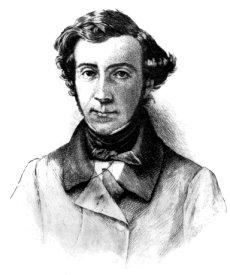
Alexis de Tocqueville
Photogavure from the 1899 edition of Democracy in America
Source:  Wikimedia Commons

 In the middle of a very long chapter entitled The Three Races in the United States is a very long section about race relations generally between the “Anglo-Americans” and the “Negroes” and about slavery specifically in the South.  I found this section to be very moving, though not perhaps for the reasons someone would expect.  Tocqueville made no pleas to emotion.  He analyzed slavery from the perspective of the whites.  From the beginning he assumed that slavery was both immoral and not economically beneficial, and asked the question, why are there still slaves in the American South?

This caught my attention, as I’ve often wondered this very thing.  From the perspective of me living in 2014, slavery is so abhorrent, so obviously wrong, that it seems completely irrational that someone living 200 years ago would consider owning another person.  Yes, the culture was different, but white southerners were still living in a Christian society, believing in the Bible.  Abolitionists preaching the immorality of slavery were all over the place.  Slavery had already been abolished in much of the world long before America got around to it.  How, then, did slaveholders justify to themselves what they were doing?  How did they rationalize their behavior?
 
1817 map of the southern United States
Published by John Thompson
Tocqueville’s explanation was very interesting.  According to him, slaveholders didn’t rationalize their behavior, exactly.  They were Christian, and they weren’t stupid.  They knew slavery was wrong.  They knew it wasn’t economically efficient.  Trouble was, they didn’t know what to do about it.  Slavery was so deeply ingrained into the economic structure, legal system, and culture of the American South that they couldn’t root it out.  Here’s an example of the difficulty:

“I happened to meet with an old man, in the South of the Union, who had lived in illicit intercourse with one of his Negresses, and had had several children by her, who were born the slaves of their father.  He had indeed, frequently thought of bequeathing to them at least their liberty; but years had elapsed before he could surmount the legal obstacles to their emancipation, and in the mean while his old age was come, and he was about to die.  He pictured to himself his sons dragged from market to market, and passing from the authority of a parent to the rod of the stranger, until these horrid anticipations worked his expiring imagination into frenzy.  When I saw him, he was a prey to all the anguish of despair; and I then understood how awful is the retribution of Nature upon those who have broken her laws.”  (Page 318).

That was honestly one of the saddest things I have ever read.  I think human nature leads us to expect that people who want to do good things will be able to accomplish them if they work hard.  Instead, this was the story of a man who tried very hard to do the right thing and couldn’t.  Tocqueville predicted that the only way to break and end slavery in the United States would be through war.  Tocqueville was right. 1

After reading this section of Tocqueville, I find myself in the odd position of feeling compassion for a group of people who I’ve always lumped into the “bad guys” category.  Slavery is absolutely, unequivocally wrong.  It shouldn’t have happened.  But . . .

I know what it’s like to feel trapped by the consequences from bad choices—my own or other people’s.  I’ve been in situations where I knew, or thought I knew, what the right choice was, but as I struggled to do right realized that I didn’t have the strength or ability required to do it.  I emerge from these difficulties with an increased gratitude for the Atonement.  Christ’s grace can break the bonds that keep us from accomplishing the good things we try unsuccessfully to do.  He can increase individuals' courage and strength and he can send a nation a Lincoln.


Tocqueville, though, thought the war would come via a slave uprising, similar to what happened in Demarara in 1823. return

Wednesday, January 15, 2014

The beginnings of the Personal Progress Program


I walk by faith, a daughter of heav’nly parents.  Divine am I in nature by inheritance.
And someday, when God has proven me, I’ll see him face to face.
But just for here and now I walk by faith.
“I Walk by Faith” by Janice Kapp Perry
Sister Kapp in 1989
Source:  lds.org

My older daughter will enter the Young Women program at the end of the month.  This Wednesday will be her first midweek activity because all the graduating Primary girls have been invited to participate.  Then two weeks later is New Beginnings, and a whole new adventure for my not-so-little-anymore girl.

I remember turning 12.  I sat on the couch in my Beehive leader’s living room; she sat to my right.  She explained Sunday YW meetings and midweek mutual activities.  We talked about the Young Women’s theme.  Then she handed me a slim book that, if I remember rightly, was white and green.  I remember flipping through the book, looking at the pictures, as Sister Georgeson introduced me to My Personal Progress.  Like the Gospel in Action program I had participated in while a Merrie Miss, the My Personal Progress program would help me to develop righteous habits through setting goals.

The program required goal-setting in six areas:
·         Spiritual Awareness
·         Homemaking Arts
·         Service and Compassion
·         Recreation and the World of Nature
·         Cultural Arts and Education
·         Personal and Social Refinement

The LDS Church instituted the Personal Progress program in 1977, making the manual available in January of 1978.  The following summer Ruth H. Funk, then the Young Women General President, wrote that “the theory behind [Personal Progress] is simple and powerful:  we want each girl to know that her personal progress is eternal, that it will never be finished in this life.  We want her to know that she can change and grow at any time in her life.” 1

Sister Georgeson also told me that this year, 1986, had marked a shift in the Young Women program.  The Church broadcasted a worldwide satellite Young Women fireside the year before, on Sunday, November 10, 1985.  At this fireside, Sister Ardeth Greene Kapp introduced seven Young Women Values.   These values, Sister Kapp explained, were “intended to serve as a guide to all Young Women in living the gospel and serving God” 2 In the Feb.  1986 issue of the Ensign, she elaborated: 
“The Young Women Values have been selected to help young women know who they are and what to stand for during a time when peer pressure and acceptance by others exert a major influence in their lives.  Understanding the values expressed in the Young Women program can help parents reinforce these principles as they help their daughters realize a righteous, happy life and strengthen their commitment to the gospel.” 3
 Later during that same fireside, Sister Maurine J. Turley, second counselor in the General Young Women Presidency, introduced a new Young Women theme:  We are daughters of a Heavenly Father who loves us, and we love him.  We will ‘stand as witnesses of God at all times and in all things, and in all places’ as we strive to live the Young Women values.  A choir then sang the new musical composition I Walk by Faith.

Although leaders in ward Young Women organizations were encouraged from the beginning to incorporate the Young Women Values into their Sunday lessons and midweek experiences, they appear to have had some trouble figuring out exactly how to do this.  4   Personally, I don’t remember any emphasis on the Young Women Values during my Beehive years.  The first spring after I became a Mia Maid, though, Young Women leaders got some help:  the Church released revised Personal Progress manuals that replaced the six suggested goal-setting areas with the seven Young Women Values.  From then on, Beehives and Mia Maids would complete 2 value experiences for each value every year, and Laurels would complete 2 value projects each year.  Sister Kapp said, “Personal Progress is an essential element of the Young Women program.  Basing this program on the Young Women theme, values, and motto can help give direction to a young woman’s life and strengthen her testimony of the gospel.” 5 At the same time, each value was assigned a color to provide a visual reminder of the values. 

Also in the Feb. 1986 Ensign, Sister Kapp talked about the importance of values and goal-setting to a young woman. 
The Young Women Values—Faith, Divine Nature, Individual Worth, Knowledge, Choice and Accountability, Good Works, and Integrity [and Virtue-Anna]—serve as a guide to every young woman.  These values can help a young woman understand who she really is and give her an identity apart from the world.  The gospel principles expressed in the Values help her to increase her faith in Heavely Father and to realize that the qualities she possesses are part of her divine nature.  These understandings will guide her in setting goals, in evaluating her progress, and in making her life purposeful. 6

Yesterday I pulled out my Young Womanhood Recognition medallion and showed it to my daughter.  I explained, briefly, the Personal Progress program, and encouraged her to work to earn her own awards.  She feels a bit intimidated, but I assured her that she can do it.  I told her that the work she puts into her Personal Progress will help her to become the young woman she wants to be.

1. Funk, Ruth H. “Why your daughter needs the Young Women Program” Ensign, (August 1978).
2. “Young Women counseled to stand for truth and righteousness” Ensign, (January 1986).
3. Kapp, Ardeth.  “Establishing a righteous identity: A conversation with Ardeth Kapp, Young Women General President” Ensign, (February 1986).
4. Thomas, Janet.  “No ordinary time” New Era, (May 1989).
5. Kapp, Ardeth.  “A conversation about Personal Progress and Young Women” Ensign, (March 1989).
6. See footnote 3.